CATHOLIC HEALTH AUSTRALIA WELCOMES PALLIATIVE CARE FUNDING BOOST
June 9, 2022
EASING THE BURDEN WHILE SEARCHING FOR A CURE
June 21, 2022


Michael Whitehead
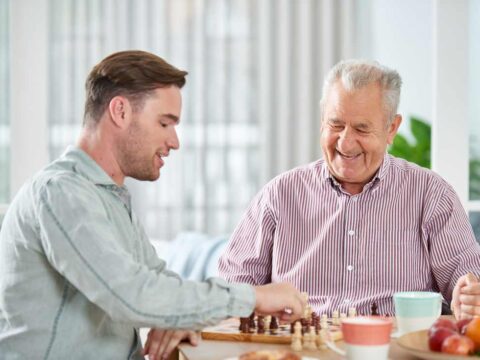
Loneliness can be debilitating, especially as we age, and Michael Whitehead wants to do something about it.
Mr Whitehead is the Men’s Health Clinical Nurse Consultant at St Vincent’s Hospital Sydney, and recently presented at the Global Action on Men’s Health and the World Congress of Public Health.
This week is Men’s Health Week and features the theme; “building healthy environments for men and boys”, and he says dealing with loneliness is one part of the solution.
“Cardiovascular disease is heightened in men who are lonely, as well as mental health conditions such as depression and anxiety
“Loneliness is not something we typically screen for in hospitals. A person can be seen with a health complaint and we’ll treat the symptoms, but the social drivers that are affecting this are often ¬– almost exclusively – missed.”
Most Australians will experience loneliness at some point in their lives and about 33% reported an episode of loneliness between 2001 and 2009, with 40% experiencing more than one episode.
Living alone and not being in a relationship are substantial risk factors for social isolation and loneliness, yet the 2016 Census found 25% of Australians live alone. Living alone does not necessarily mean you are lonely, but many people, particularly men who do live in solo households, can report lower social connections.
Mr Whitehead says it is widely acknowledged that as men age, their close friendship circle reduces in size, which is not the same (and often the opposite) for women.
Those who don’t have social connections, can at times, fall into depressive states and find it difficult to navigate their way out or seek help.
Activities such as volunteering, joining an interest group or even a dog park are simple ways men can begin to broaden their social circle.
“For men, often the longest mile is from their front door to another door,” he says. “We need to strengthen the ability for men make that short journey across the loneliness divide and reap the rewards that social connection brings.”
“Our society is improved when we begin to develop connections that lead to friendship, and which then add additional meaning into our lives,” he says.
“I advocate and direct male patients to validated social support initiatives such as the Men’s Shed and The Men’s Table, as a way to responsibility care for the psychosocial needs of our men.
“My role is to say to men, ‘we’ll do the required health assessments, start a conversation with you, and if you like, I’ll make those connections for you with a Men’s Shed, Men’s Table or another group of your choosing.”
Mr Whitehead says there is also evidence that some younger men can suffer loneliness, and could benefit from a similar approach.
“It’s true social outlets such as Men’s Sheds are typically retiree oriented,” he says.
“But there are interesting case studies coming from Ireland – where the Men’s Shed movement has rapidly expanded – where many younger men in their 30s are joining Sheds, so you have these lovely grandfather-grandson relationships developing
“It’s also a way for young people to go out and develop social skills, because when you lonely and isolated, it can be sometimes difficult knowing how to initiate contact and connection.”
Mr Whitehead, who also serves on the nursing advisory board of Healthy Male (Andrology) Australia, is the clinical lead for the soon-to-be-launched St Vincent’s Men’s Health Centre, which will be based in Sydney’s Darlinghurst. The philanthropically sponsored centre’s first stage will focus on prostate cancer.
“The St. Vincent’s Men’s Health Centre will jointly be focused on treating disease, and also on the psychosocial supports that men find hard to engage in,” he says.
“After the St. Vincent’s Men’s Health Centre is up and running, we will look at wider health needs relating to men’s health, and our clinical staff will also be examining new ways to engage with men to build healthier communities”