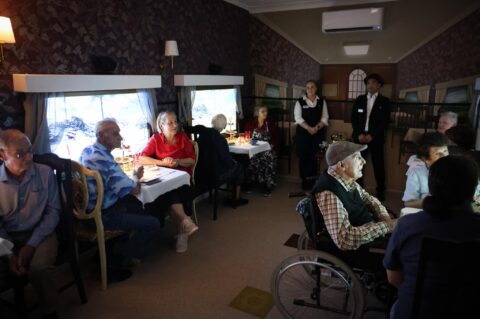

Aged Care needs greater protections for people in financial hardship
February 24, 2025
Welcoming Extra Funding for Public Hospitals
February 25, 2025

Catholic Health Australia (CHA) acknowledges the release of Victoria’s Voluntary Assisted Dying (VAD) review, which we contributed our own experiences to. We will assess the full recommendations in due course.
Our member services do not facilitate or participate in assessments undertaken for the purpose of a patient or aged care resident having access to, or making use of, the interventions allowed under the Voluntary Assisted Dying Act. Our services choose instead to specialise in end-of-life care such as palliative care.
We are committed to responding openly and sensitively to our patients, residents and their families about any legal options they may be exploring.
We remain concerned about advocacy to the federal government permitting the VAD process to be arranged by a carriage service, as outlined in the review. This would exacerbate the lack of protection for patients experiencing duress, undue influence, elder abuse and mental impairment, which cannot be appropriately assessed via phone or a Zoom call.
In many regional and rural areas, such a move would make VAD more accessible than end-of-life and palliative care, raising the prospect that people feel compelled to explore ending their lives due to a lack of care options.
We welcome the discussion in the review regarding funding issues related to the implementation of the VAD process. This reflects concerns raised in our submission as non-participating entities. Regardless of whether a health service offers VAD, the legalisation has required upskilling of the whole workforce, advanced skills in end-of-life discussions and care provision, and the availability of a support structure to enhance complex decision-making, all of which requires adequate resources.
While deeply concerned about the expansion of the laws, we are committed to working with all people of goodwill as any legislative changes are drafted. We encourage the Government to engage in significant consultation with our sector on this issue.
Our focus remains on ensuring that every Australian has access to high-quality, properly funded palliative care, particularly those living in regional and rural locations where access is often an issue.
We know that palliative care is chronically underfunded and under-resourced, despite being the preferred option for many patients and families facing end of life. We urge policymakers to prioritise investment in palliative care services so that all individuals can receive the care, support and dignity they deserve in their final days.
Rebridge Group polling, commissioned by Catholic Health Australia, has found that 87 per cent of Australians believe palliative care should be universally accessible.